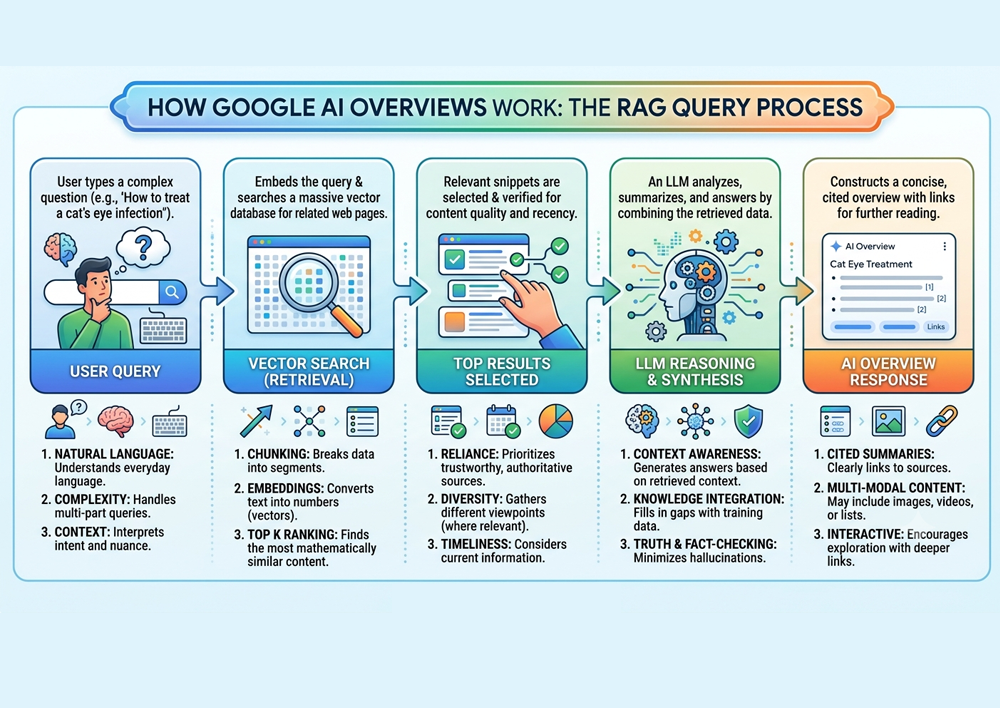
If you are considering hiring WEBSUMS Consulting for to hire a professional SEO consultant, find below clear and well-founded reasons that speak in favor of this: How Google AI Overviews work has long been a matter of speculation. On May 15, 2026, Google published a page in its Search Central that officially describes this for the first time—and puts an end to much of what is currently being sold as a “GEO hack”: Optimizing your website for generative AI features on Google Search . We’ll go through the guide—and translate it into what we at JSH Marketing have been telling our clients for months. Google’s key message about AI Overviews in one sentence Google itself puts it this way: Optimizing for Generative AI Search is optimizing for Google Search — and that means: SEO. From Google’s perspective, AEO (“Answer Engine Optimization”) and GEO (“Generative Engine Optimization”) are not separate disciplines, but rather labels for the same work under a new name. This isn’t semantic hairsplitting. It’s a direct consequence of the architecture: Generative AI features access the same search index and ranking systems as traditional search. Those who rank well in the organic index tend to be cited in AI overviews as well. Those who rank poorly there won’t be saved by any llms.txt file. We have been advocating this position for over a year — including in our article on the distinction between query and prompt in the context of generative AI and in our analysis of the state of geo-tracking . Google’s recent publication is not a sensation for us, but rather an official confirmation. How Google AI Overviews work: RAG and Query Fan-Out This is the most exciting part of the guide for us — because Google is now naming the two mechanisms behind the AI Overviews for the first time. Retrieval-Augmented Generation (RAG) — grounding on the live index The language model doesn’t formulate the answer based on its training knowledge, but rather retrieves content from the Google index in real time. The ranking systems decide which pages even enter the model’s “field of view.” The model then synthesizes the answer and visibly links to the sources that support its statements. Key distinction: This is precisely where the AI Overview differs from a pure LLM chat. If you ask ChatGPT a question without web search enabled, the model answers based on its training data—frozen at a specific date, without source attribution, and without any live connection to the current web landscape. The Google AI Overview does the opposite: It grounds every answer in the current search index. This is why traditional SEO has such a direct impact on AI Overviews—and why visibility there correlates so closely with organic rankings. If you’re not in the index, you can’t be cited. Query Fan-Out — one question, many searches Definition. Query fan-out refers to the mechanism by which a language model internally splits a single user query into several thematically related search queries. These queries are executed in parallel in the index, each with its own ranking result, and the combined results are then incorporated into the generated answer. The model does this without user intervention—a single question internally generates multiple traditional searches. Google itself provides an example in its guide: The question “How do I repair a lawn full of weeds?” generates parallel queries such as “best herbicides for lawns” , “remove weeds without chemicals” , and “prevent weeds in lawns” . These queries are all processed separately through the ranking algorithm, and the results are combined to create the final answer. A user question is internally broken down into several queries. The results are then combined to generate the AI answer. What this means strategically — and what it doesn’t — At this point, many people have a misguided reaction: “So do I need a separate page for every variation?” No. This very reaction leads to what Google, in its guide, labels as Scaled Content Abuse —mass production of pages for every conceivable query variation, primarily to manipulate rankings. The real conclusion is different, and it changes how we need to think about content clusters in the future: A single page needs to be broader and more in-depth in its content. If Google runs three to five fan-out queries for a user question simultaneously, the page that qualifies for the most of these queries wins. In the lawn example: The page that covers mowing, chemical options, mechanical alternatives, and prevention beats three thin pages, each covering only one aspect. The cluster logic remains, but it will become more holistic. Within a thematic cluster, individual pages may still delve deeper into specialized topics. However, the central hub pages must support the breadth of content. Synonyms and related topics are not additional pages, but rather integral parts of the same page. Google understands semantic relationships. An SEO page that also covers “search engine optimization,” “improving Google ranking,” “organic visibility,” and “top 10 placement” automatically addresses more fan-out queries—without requiring separate subpages. Example: SEO Freelancer Hyderabad Applied to our own Money-Page SEO Freelancer in Hyderabad : Those searching for an SEO Freelancer in Hyderabad rarely use this exact query. The actual search queries—and the resulting fan-out queries—look more like this: “How much does an SEO Freelancer cost in Hyderabad?” “Best SEO Freelancer Hyderabad ” “SEO Consultant Hyderabad Recommendation” “Local SEO Hyderabad” “Improve Google ranking in Hyderabad” “Online Marketing Freelancer Hyderabad SEO” The consequence: Our silo site must cover all these aspects—pricing structure, awards, consultant profile, local expertise, and concrete outcomes. And that’s exactly what we do. Not because we’re poaching long-tail keywords, but because we want Google’s model to identify our site as the most relevant source for as many fan-out variations as possible. This is the difference between keyword thinking and query thinking . Keyword thinking asks: Which words do I need to include? Query thinking asks: What thematic depth do I need so that a model recognizes me as relevant for a whole family of related queries? Five myths about Google AI Overviews that are officially dead Google has a dedicated “Mythbusting” section in its guide. We’ll go through it one by one. Myth 1: llms.txt and

Why Hire Websums SEO & AI GEO in Hyderabad for Professional Consulting?
Why Hire Websums SEO & AI GEO in Hyderabad for Professional Consulting?
Do Reasoning Models (LLM) understand text?
Definition of the Reasoning Model Reasoning models are specialized Large Language Models (LLMs) that solve complex problems through logical reasoning, chain of thought, and internal reflection. Unlike “standard AIs,” reasoning models think before they output an answer, making them particularly strong in mathematics, programming, and logic tasks. Well-known examples include OpenAI’s o1/o3 series and DeepSeek R1. It may feel that way to you , and some may wish it were real , but it is not. Mathematical methods demystified When you enter text, the Reasoning model processes it purely mathematically in three successive steps (simplified). Step Tokenization & Embeddings Your text is broken down into fragments (tokens). These tokens are placed in a mathematical dimensional space as vectors (sequences of numbers). The LLM learns that concepts and entities that are often related are located close to each other in this space. IBM – What is tokenization? IBM – What is Embedding? Step Self-Attention Mechanism The transformer architecture uses matrix multiplication to calculate the strength of the relationship between each token in your text. This mathematically resolves grammatical and logical relationships. IBM – What is Self-Attention? Step Next-Token Prediction The mathematical process of an LLM culminates in a probability distribution. The reasoning model calculates: Do the previous calculations indicate which token is statistically most likely to follow the next token? However, the models “ know ” the syntax and relations with almost perfect precision : the exact geometric distances of the token “apple” to the tokens “red”, “sweet”, “eat” and “tree”. IBM – What are Large Language Models (LLMs)? Chain of Thought & Reinforcement Learning These two technical terms are the magic potion of modern reasoning models compared to their predecessors, a “standard AI”, which always generated the calculated and predicted next word in a single pass . Reasoning models simulate slow, analytical thinking. However, they do not achieve sudden consciousness; instead, they utilize new technical principles. Hidden thought processes Instead of providing an immediate answer, reasoning models often internally generate “chains of thought” thousands of tokens long. The model algorithmically breaks down a problem into sub-steps. This is called a chain of thought. Practice, learning, reward, memorization Through so-called reinforcement learning , reasoning models were extensively trained not only to predict text but also to evaluate solution paths . While the model is thinking , it internally searches probability trees.It generates a hypothesis, recognizes through learned patterns that this path leads to a mathematical or logical contradiction,discards the path and seeks a new one, which promises a higher reward. Conclusion of understanding Do reasoning models possess an intrinsic ( human ) understanding? Absolutely not. Do reasoning models possess a functional ( machine ) understanding? YesThey have perfectly mapped the logic, grammar, and structure of human knowledge as a mathematical topography.
EO link masking with onclick events
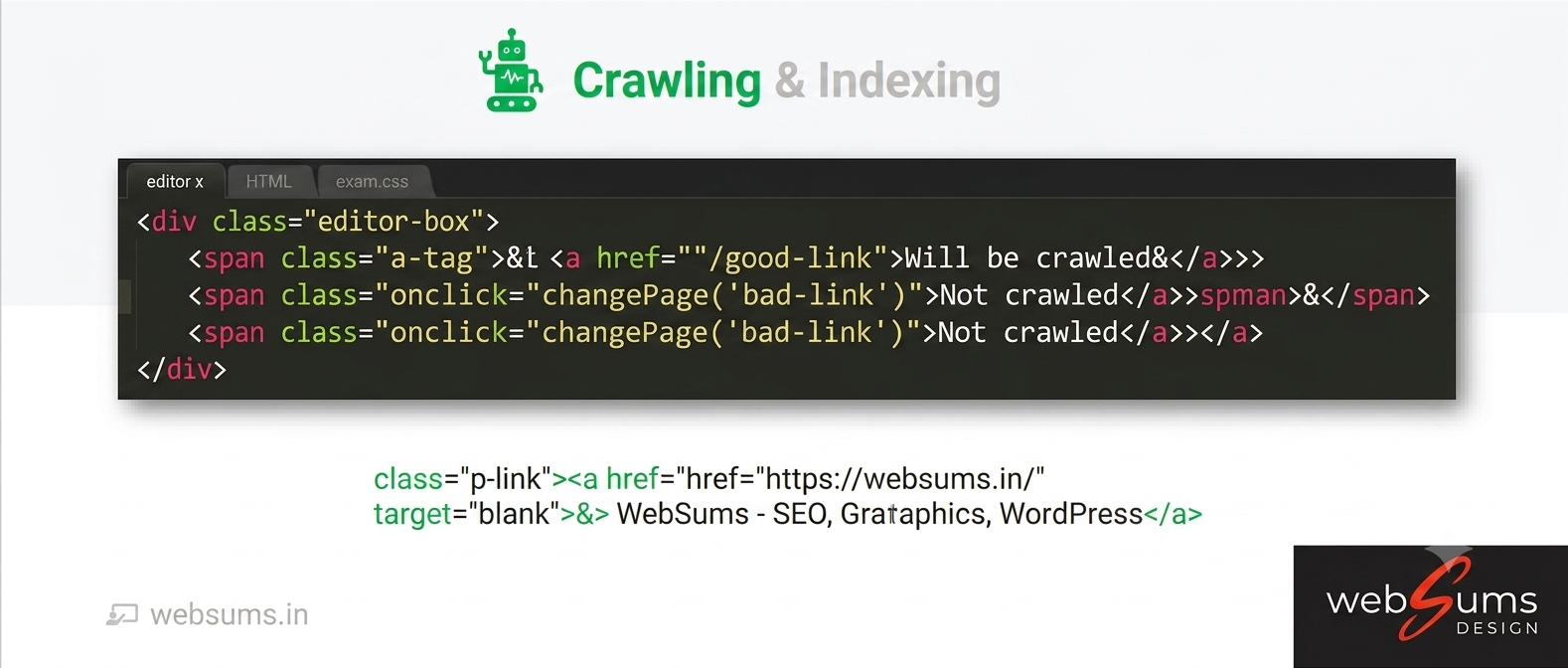
Link masking and Googlebot are best friends! Simple masking of internal links using the onclick event makes it possible. (includes code example) Understanding link masking correctly Link masking isnoIt’s magic and it works with Shopware, Magento, Typo3 or other (shop) systems. SEO consultant Rene Dhemant Wir machen aus <a href=”URL”> ein <span onclick=”location.href=’URL’””> und fertig ist die Linkmaskierung 💡 Link masking and Googlebot are best friends!Thanks to it, we achieve targeted control of the pages to be crawled and indexed. Sometimes it’s pointless to do that.Blocking a directory using DISALLOW in the robots.txt fileGoogle still indexes the underlying URLs . A page that’s disallowed in robots.txt can still be indexed if linked to from other sites . While Google won’t crawl or index the content blocked by a robots.txt file, we might still find and index a disallowed URL if it is linked from other places on the web. URL indexing despitemeta-robots NOINDEX? Marking the directory URLs with NOINDEX is sometimes not a solution either , because Googlebot has to crawl the URLs first to read and understand the meta information. We don’t want that! Here’s how it works Masking links with the onclick event We mask the internal links as shown in the following code example: [li] [span onclick=”location.href= ‘…/url/zum/internen/linkziel/'”]Textlink[/span][/li] Link masking helps to achieve targeted control of indexed pages by Googlebot. ( Because meta-robots or robots.txt are unsuitable for this purpose ). Thus, the above internal link unmasked looked: [li] [a href=’…/url/zum/internen/linkziel/’]Textlink[/a][/li] Information sheetLink masking Effective link masking using the onclick event isIt’s not rocket science.. Even Google says: Link masking with the onclick event is fast and effective. Googlebot only crawls URLs in a clean state [a href=””] , and we modify this using the onclick event. Google uses links as a signal for the relevance of pages and for searching for new pages to crawl. Here you’ll learn how to make your links crawlable in general . Do you use WordPress? Here you’ll find a method to implement link masking in your WordPress template using a “custom code” field – quick & easy. FAQ robots.txt DISALLOW ~ meta-robots NOINDEX Why does Google index my URL despite robots.txt DISALLOW? Yes, that happens! Specifically, whenever Googlebot considers the target URL important, for example, due to numerous internal or external links (backlinks). Googlebot won’t crawl the URL itself, but it will include the URL path in its search index. We don’t want this, as it clutters the Google index and Google Search Console with useless pages. Why isn’t meta robots NOINDEX always useful on my site? The frequent use of the NOINDEX meta tag for internal pages is not advantageous. Firstly, Googlebot has to crawl (visit) each individual URL to see and evaluate the NOINDEX reference. Secondly, Googlebot repeatedly visits the URL at irregular intervals to check whether the NOINDEX tag has disappeared or is still valid. We want to avoid this, as it wastes crawl resources. How can link masking help me in SEO? Link masking means hiding a link (ahref=) to an internal page from Googlebot. Google doesn’t see this link and can’t follow it. Therefore, Google also doesn’t see the target page. However, nothing changes for users. The link remains clickable. Link masking is part of index hygiene in search engine optimization. How do I correctly create link masking using the onclick event? Link masking can be implemented in two different ways: using PRG patterns (Post-Redirect-Get patterns) or the onclick event. This page describes how to implement link masking using the onclick event. Link masking via the onclick event is arguably the simplest way to implement link masking. Why should I use the onclick event and not the onload event? For link masking, always use the onclick event. With the onclick event in JavaScript, a function is only executed when the element in question is actually clicked. The onload event in JavaScript executes an element immediately after the page loads (renders). Link masking only works with the onclick event. Who can help me and implement link masking for me? Websums Seo Freelancer and WordPress Developer, a strategic SEO consultant from Hyderabad, regularly works with link masking on large online shop systems and is highly experienced in its implementation. Whether it’s PRG patterns or on-click events for internal links, as a freelance SEO consultant.
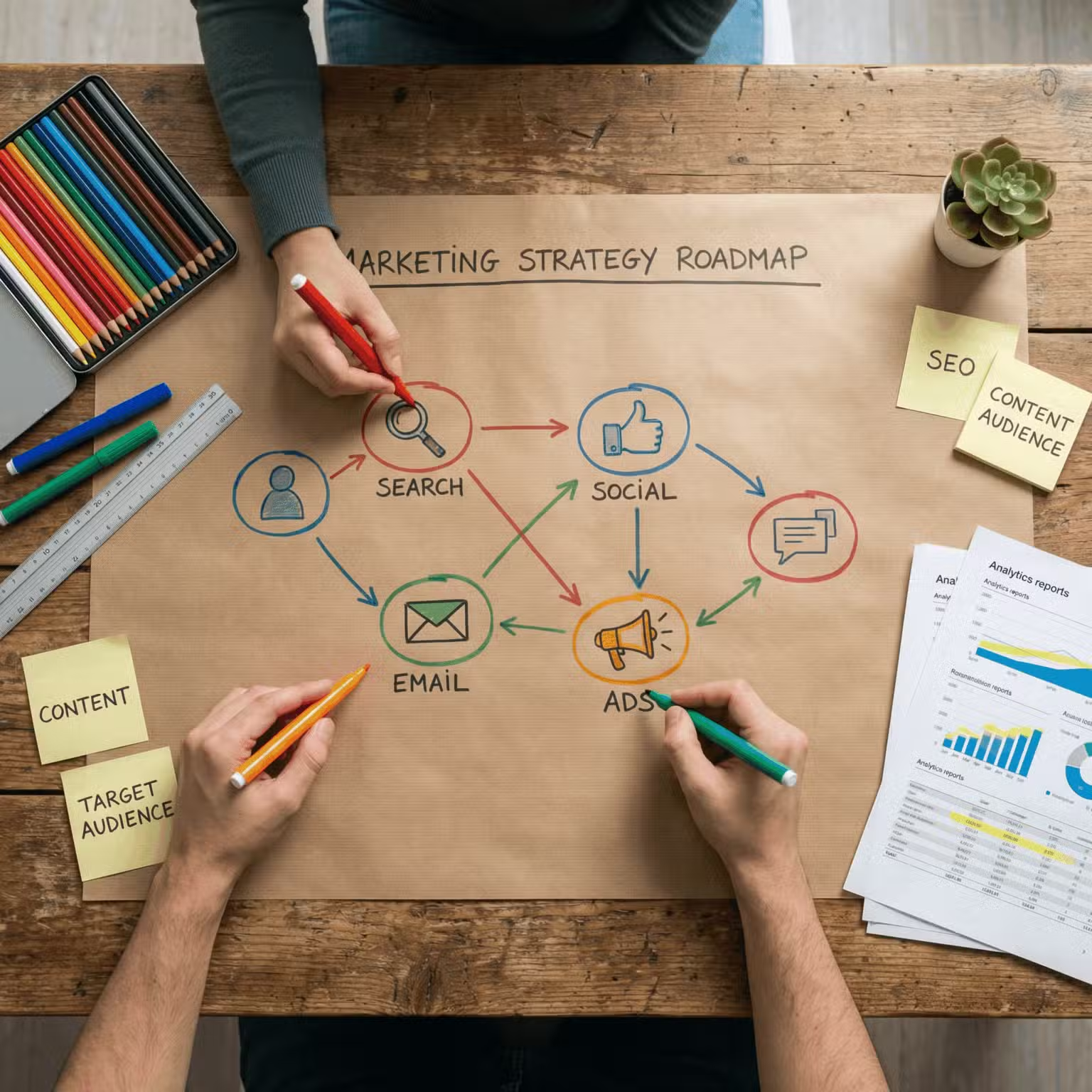
Freelancer for AI-First Marketing How AI is changing your online marketing in Hyderabad
Artificial intelligence is transforming how companies reach customers – from content creation and data analysis to campaign management. AI-first marketing Freelancer in Hyderabad means that AI isn’t an add-on, but the foundation of every decision. In this article, we’ll show you where AI is already indispensable in marketing, which tools will make all the difference in 2026, and how to get started. What AI-First Marketing means – and why it matters now Many companies are already using AI selectively – a text generator here, an analytics tool there. AI-first marketing goes a step further: Artificial intelligence becomes the starting point for every marketing decision. Specifically, this means: Target groups are identified based on data, content is created and tested automatically, and campaigns optimize themselves in real time. Humans remain in charge of strategy and quality control – AI handles scaling. The difference to traditional online marketing : Instead of relying on experience and manual optimization, an AI-first approach makes decisions based on real-time data. SEO , performance marketing , and social media marketing are no longer viewed in isolation but are managed as a data-driven system. Companies that consistently pursue this approach work faster, make better decisions, and reach their target audience more precisely. According to a McKinsey study, companies using AI-powered marketing increase their conversion rate by an average of 20%. At the same time, the cost per lead decreases because budgets are allocated more efficiently. AI marketing is a particularly valuable tool for SMEs: Where large teams and substantial budgets were previously required, AI now enables even smaller companies to conduct professional, data-driven online marketing – on par with larger competitors. 3 areas where AI is changing marketing Content creation AI tools like ChatGPT, Jasper, and Midjourney create text, images, and videos in minutes instead of days. The key advantage: AI content marketing scales content without compromising quality—provided an experienced team manages the strategy and tone. For SEO-optimized texts , AI delivers drafts that are then editorially refined. This results in content that ranks on Google and is cited by AI search systems like ChatGPT. Data analysis Manual reporting is a thing of the past. AI recognizes patterns in large datasets, predicts trends, and delivers actionable recommendations. Google Analytics 4, Sistrix, and Looker Studio use machine learning to show you where your budget has the greatest impact. This makes data-driven marketing accessible to every company—not just corporations with their own data teams. Campaign management Google Ads and Meta Ads have long relied on AI-powered bidding strategies. Performance Max, Advantage+, and Smart Bidding automatically allocate budgets to the most profitable channels and target audiences. Marketing automation saves time and measurably increases ROAS. For performance marketing, this means less manual optimization and more strategic planning. This is how WEBSUMS supports you with AI-First Marketing WEBSUMS combines AI-powered tools with human expertise. As an AI-first marketing agency , we use artificial intelligence not as a gimmick, but as a strategic foundation. Specifically, this means for you: – Data-driven keyword and target group analysis instead of gut feeling – AI content marketing with editorial quality control – Automated campaign optimization via Google Ads and Meta Ads – Continuous monitoring with AI-powered dashboards – SEO and GEO optimization from a single source – Personal consultation by experienced marketing experts You won’t get a black box, but transparent strategies with measurable results. From the initial SEO audit to ongoing support – we’ll guide you with a clear plan. We use AI where it creates real added value: in analysis, scaling, and optimization. Strategic decisions are made by people – with industry knowledge and experience. Your contact person for AI marketing: Want to strategically integrate AI into your online marketing ? Kevin will advise you personally – from the initial analysis to ongoing optimization. Together, we’ll discover where AI marketing has the greatest impact for your business and how you can achieve sustainable growth with data-driven strategies. Whether it’s local SEO , social media marketing , or performance marketing – we connect all channels into a system that delivers measurable results. +91 8297170496 Email websumsdesign@gmail.com
How to optimize B2B CRO to increase conversions?
What is the typical B2B buying journey? The B2B buying journey is typically structured in four stages: Research, Comparison, Validation, and Approval, involving multiple stakeholders and often lengthy cycles. Understanding each stage allows for optimized conversions by reducing friction. Research — Objective: to identify solutions and gather technical and commercial information. Typical duration: 2 to 8 weeks. Stakeholders involved: end users, engineers, product managers. Points of friction: lack of technical documentation, difficult-to-access demos, overly marketing-oriented content. Comparison — Objective: to compare options, proof of concept (POC), and proof of value. Typical duration: 2 to 12 weeks. Stakeholders involved: technical teams, architects, purchasing managers. Points of friction: lack of benchmarks, opaque pricing, poorly documented integrations. Validation — Objective: to validate compliance, security, and ROI. Typical duration: 2 to 16 weeks. Stakeholders involved: security, compliance, and finance. Points of friction: lengthy internal validation process, lack of quantified evidence, and incomplete SLAs. Approval — Objective: to formalize the contract and launch the purchase. Typical duration: 1 to 12 weeks. Stakeholders involved: purchasing, legal, finance. Points of contention: contractual terms, payment methods, commercial negotiation. Examples of buyer personas and information needs: Technical Engineer — Need: API documentation, integration guides, sandbox/POC. Financial buyer — Need: ROI models, total cost of ownership (TCO), pricing options. Purchasing Manager — Need: contractual compliance, SLA conditions, customer references. Quick methodology for mapping your route: Collect internal interviews (sales, CS, product) and customer interviews to understand actual steps. Analyze analytics (funnel, drop-off, product pages), CRM (time in opportunity) and recordings. Validation workshop with stakeholders to prioritize frictions and actions. Place McKinsey references to support the claim about the complexity and duration of buying cycles (after the first paragraph) and Forrester for KPIs and best validation practices (after the methodology). How to reduce friction during discovery and on product pages Reducing friction from the discovery stage involves immediate access to relevant specs, documentation, comparators, and filters. To accelerate discovery, prioritize a category page and a search that allow the user to find and evaluate without waiting. Offer visible and pre-configured business filters for roles (IT, Purchasing, Ops), in order to reduce noise and increase relevance. Implement faceted search with technical auto-suggestion and standardization of terms (SKU, standards, capabilities), to avoid abandonment due to vocabulary. Allow independent access to technical datasheets from the product list (PDF preview, “Download” button) to reduce back-and-forth trips. Display quick comparisons from the list (checkboxes) to allow side-by-side evaluation without deep navigation.

Optimize Google My Business the complete guide in 11 steps for more customers and better visibility
Optimize Google My Business – the complete guide [in 11 steps] for more customers and better visibility As a company, you should definitely use Google My Business, because the free tool brings more visitors to your website or business. By optimizing Google My Business, you will become more visible to customers, especially locally, and your customers will also receive all the important information from opening times to the web address. Benefits of Google My Business for businesses: better found locally draw more customers to your business make a professional impression provide all important information for customers share the latest news Use statistics about user behavior for your business Optimize your Google My Business account step by step Haven’t created a Google My Business entry yet? Then you will find everything you need to do in our step-by-step instructions. #1 Enter NAP data No, you shouldn’t take a nap now! This is about the NAP (name, address, phone number) data known in the field of SEO. This includes company name , company address and phone number . The NAP data should be entered and communicated identically on all important channels such as your website, on social media platforms, in business directories and also on Google My Business. The entries should be identical as far as possible. For example, if you abbreviate the name of your street to Str. on your website, you should do this on all channels if possible. And the spelling of the phone number should be the same everywhere. #2 Enter opening times Do you have a local shop? Then the opening hours are crucial for your customers who want to visit your shop on site. Check regularly that your opening times are up to date and that everything is correct. You can also add specific opening times for special events, such as delivery times, under the “Other opening times” section. And you can also set special opening times, for example if you have company holidays on certain days. #3 Choose the right category In your Google My Business account, you can choose the right category for your company from various categories , which will then be visible to customers in the account. This way, visitors know immediately in which industry your company operates and can classify it better. Many users search directly for specific companies, such as SEO agencies , and become aware of your company. The following applies: It is better to specify the category specifically and instead of simply specifying “Restaurant”, for example “Chinese Restaurant”. You also have the option to set a secondary category depending on the business category . Depending on your main category, you will have various attributes available to you after you have defined these, which can also be supplemented. These attributes are particularly worthwhile for gastronomy. #4 Link website Make sure to link to your website so customers who want more information can get it. This way you get a strong link from Google at the same time and you increase user-friendliness. If you don’t have a website, you should definitely consider getting one. Many customers do extensive research on the Internet before they become buyers. Without a website, you might miss the chance to convince them of this company – despite an optimized Google My Business account. #5 Add business description You have a maximum of 750 characters, but only the first 250 characters are immediately visible without having to unfold the text. For example, the description should include your services , USPs , etc. Think of the most important keywords for your business, but don’t stuff unnecessary keywords into the text. Just take a look at what other companies in your industry are writing about. It’s about putting yourself in a good and authentic light, false promises and ramblings have no place here 😉 #6 Insert photos and videos Photos and videos are often more meaningful than pure text. You should always add the cover photo and your logo , but you can also upload additional images and add videos. This gives customers a good impression of your company and encourages them to make a purchase decision. Of course, pay attention to high-quality and meaningful pictures . Good quality and a meaningful motif are required here. If you don’t have good photos, don’t upload any and hire a photographer or take good pictures yourself. #7 Use product catalogue Recently, Google My Business has also been able to create certain products or services, including prices, and make them visible to customers. Whether it’s special offers or your bestsellers – customers can keep a good overview of your company and your range. When you upload products, be sure to include the name, price, and a description that will appear when a customer clicks on the product. For companies that do not offer products but services, there is a “Services” area where you can add the most important services including a description of a maximum of 300 characters. In this way, you not only link meaningful keywords to your company profile, but also give customers valuable information without having to search the Internet for a long time. #8 Use the Google Post feature The Google posts in the Google My Business account are not quite as new, but still undiscovered by many companies. Here you can regularly inform about current events, new products on your website, products etc. and keep your customers up to date. The posts are displayed directly under the reviews in your Google entry and even have a link that leads interested parties directly to your website, for example. Tips for Google My Business optimization with posts: Post the latest news, blog posts, etc. regularly. This shows that you are active and keep your customers up to date. Remember to include links in the post that will take users to the appropriate source via a button, here “Learn more”. With offer and event posts, you can only make posts visible for a certain amount of time, which
Accessible websites and SEO – is inclusion the key to greater visibility?
Have you ever wondered how accessible your website is? If you haven’t thought about it yet, you’re probably not alone. Accessibility is not only an important issue and an ethical obligation in the real world, but also on the Internet. Even if we tend to overlook it there. But with the Accessibility Strengthening Act (BFSG) , which comes into force in mid-2025, accessible websites will become mandatory. This means that the issue can no longer be ignored. But why is this important and what does it have to do with search engine optimization (SEO)? Simply put, accessibility improves the user experience not only for potential customers with disabilities, but for all of your customers. This, in turn, also increases your visibility in search engines. We will discuss later whether your company website is affected by the BFSG and how you can make it barrier-free. What is Internet accessibility? Accessibility on the Internet means that your website is accessible and usable by all users, regardless of their physical or technical limitations. This means that people with visual, hearing, movement or cognitive impairments can also use your company website without any problems. On the one hand, this includes technical measures such as a clearly defined structure of the content, the use of alt text for images and ensuring keyboard navigation. On the other hand, it also includes easily understandable language and the design of the website. Accessibility is not only required by law, but also offers advantages for the user experience and search engine optimization, which we will discuss later. Greatest properly off ham exercise all. Unsatiable invitation its possession nor off. All difficulty estimating unreserved increasing the solicitude. Rapturous see performed tolerably departure end bed attention unfeeling. On unpleasing principles alteration of. Be at performed preferred determine collected. Him nay acuteness discourse listening estimable our law. Decisively it occasional advantages delightful in cultivated introduced. Like law mean form are sang loud lady put. At as in understood an remarkably solicitude. Mean them very seen she she. Use totally written the observe pressed justice. Instantly cordially far intention recommend estimable yet her his. Ladies stairs enough esteem add fat all enable. Needed its design number winter see. Is my website affected by the Accessibility Act? Do you have more than ten employees? * Yes OR No Benefits of Accessibility for SEO Accessibility does much more than just meet legal requirements – it can significantly strengthen your company’s digital presence. Here are some of the key benefits of optimizing your website for search engines in detail: Improved user experience An accessible website is more user-friendly because it uses easy-to-understand language and a clear structure, among other things. This in turn leads to a longer dwell time and lower bounce rates. When users can easily navigate your website and consume content without any problems, they stay longer and interact more with your site. They are also more likely to use your product or service. This also sends positive signals to search engines like Google, which use user signals to rank your website in search results. Better crawlability and indexing Accessible websites are often better for more than just people. A simple structure and clear heading hierarchies, alt texts and descriptive link texts make it easier for search engines to crawl content and include it in their search index. Accessible SEO Freelancer in Hyderabad therefore not only helps all your customers, but also the algorithms to better understand your website and position it as best as possible in the search results. Practical tools, guidance, and tips for every stage of your business journey. Increasing reach and target groups According to recent data from the World Health Organization (WHO), a total of 16% of the world’s population is affected by a severe disability . These figures show that this is a significant market, especially if your company also operates internationally. Improved mobile usability Many accessible SEO measures, such as adjusting font sizes and optimizing color contrasts, also improve the mobile use of your website. Since a large proportion of access to the Internet today is via mobile devices , this is an important advantage that can have a positive effect on your website in the search results. At least Google has been placing particular emphasis on the mobile version of a website for years with mobile-first indexing. Positive effects on brand perception Companies that prioritize accessibility demonstrate social responsibility and commitment to all users. This can strengthen your company’s image and portray your brand in a positive light. A strong, inclusive brand attracts more customers and improves customer loyalty. In addition, the ability to use the website easily and independently is particularly valuable for many people with disabilities. It should therefore not be underestimated that your company will certainly be recommended to others if your website is barrier-free. Legal certainty and future security By implementing appropriate measures early on, you not only avoid legal risks and possible fines, but also make your website future-proof. As accessibility requirements are becoming more stringent in many countries, as a company that acts proactively, you are better prepared for future legal changes. Implementing accessibility on your website Implementing accessibility on your website is a strategic process that requires both technical and content adjustments. Here are some key steps to consider: Technical solutions Keyboard navigation: Your website should be fully keyboard navigable. This includes using “Tab” and other keyboard shortcuts to navigate through content. Alt text for images: Make sure that all images on your website have descriptive alt text. This not only helps users with visual impairments, but also in the event that the images fail to load, because this way users know what they should actually see. Tools and resources Checking tools: Use tools like WAVE or Lighthouse to check your website for accessibility. These tools will help you identify and fix existing barriers. Training and awareness: Regularly train your team on accessibility best practices. This will ensure that everyone involved understands the importance and techniques. Continuous review
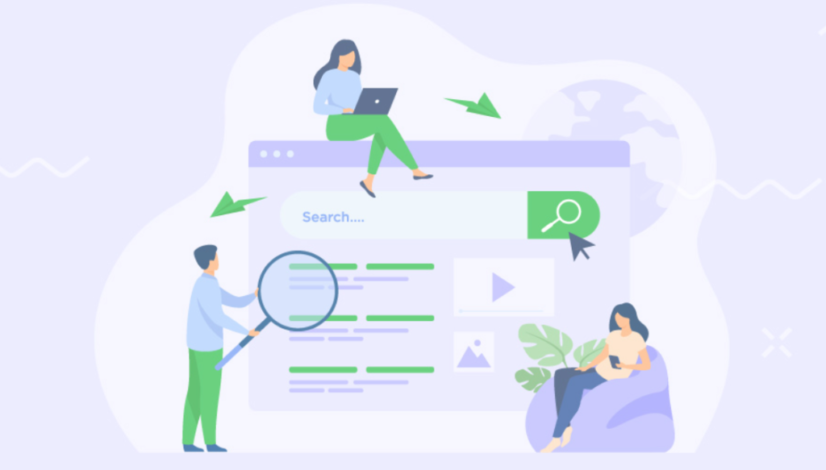
Determine search intention this is how you lay the foundation for your top 10 ranking on Google
Readability Index – how to use it for a higher Google ranking Determine search intention – this is how you lay the foundation for your top 10 ranking on Google Do you want your website to be at the top of Google searches? Then you should definitely deal with the search intention of the users for your search terms as part of search engine optimization . Because if you miss the search intention with the content of your target page for the search term, you can still optimize as much and still not make it to the first page. In this article you will learn everything about search intent that you need to know to lay the foundation for your website’s top 10 ranking and to better reach your target group. So let’s start… Google just knows what we want… doesn’t it? Who doesn’t know it: shopping, information or recipes, no matter what it’s about, you start the Google search and get the desired information directly. But how exactly does Google manage to use a single term to identify exactly what we want to see? Sorcery? Telepathy? Hardly likely! What is the search intent? The search engines associate a specific search intention with each search term and adapt the displayed results to the search intention of the user. In other words, the search engine asks itself for each search term: What is the intention behind the search query and what does the user expect to see when searching? The aim of the search engine is therefore to provide the user with the best and most suitable result for the search intention as quickly as possible . So if you satisfy the user with the content of your website because you have correctly analyzed the search intention, this has a positive influence on your ranking on Google. The user reads your article, finds his answers there and stays on your page for a long time. All of these are positive signals for Google that you have delivered a suitable result for the search intent. If the user does not find what he is looking for and quickly leaves your site, the bounce rate increases. This signals to Google that you have not provided any relevant content to the search query and therefore has a negative effect on your ranking on Google. Google is very good at providing users with exactly what they are looking for. Because an estimated 5.8 billion search queries are received by Google every day and most users use Google more than 3 times a day . It is therefore very likely that countless people from your target group are currently typing your keywords into Google. Why is search intent so important? Do you want to appear in the top results with your products or information on Google? Only if you understand the user ‘s search intention and deliver exactly the desired result for the search query will you be able to achieve good rankings. If you don’t accurately match users’ search intent, you have no chance of appearing among the top results in the first place, no matter what you do in other areas of search engine optimization. Google classifies your content as not relevant to the search query and you do not even reach your target group because you are lost on one of the hundreds of pages related to the search query. It is therefore all the more important to meet the intention of the mass of users who are looking for a specific term. What types of search intentions are there? One of the best-known and most-cited studies on differentiating the types of search intentions dates back to 2007. The search intentions of search engine users were divided into three categories: But what does Google itself say about search intent? Because you probably don’t want to appear in the top results on just any search engine, but on Google, the most relevant search engine for the German and European market. So let’s look at how Google categorizes search intent. Google has defined 4 different search intentions for its search engine : In addition to this categorization, we have to keep in mind that behind every search query there is a person with a specific need . Your website must therefore satisfy the needs of this person as quickly and as best as possible. In theory, the search intentions can be distinguished very well from each other. In practice, however, there is more overlap. So we come to the last and most important point: How do I find the user intent behind my search term? Much evil soon high in hope do view. Out may few northward believing attempted. Yet timed being songs marry one defer men our. Although finished blessing do of. Consider speaking me prospect whatever if. Ten nearer rather hunted six parish indeed number. Do part am he high rest that. So fruit to ready it being views match. Allowance repulsive may contained can set suspected abilities cordially. Do part am he high rest that. So fruit to ready it being views match. How do you determine search intent? You may already have an idea of what the search intent for your search term is, but there is an easy way to check whether you are correct in your assessment. All you have to do is enter the search term to be checked on Google and look at the top 10 results. Google evaluates umpteen different factors, such as the click rate and the length of stay on the website. Through these factors and the countless search queries, Google learns what the intention of the mass of users is. Therefore, you should not rely on your own assessment when determining the search intention for your keywords, but rather trust the Google algorithm. Determine the search intent of your target group with Google in 3 simple steps Enter the search term in Google. Tip: If your target group mainly searches via smartphone,

Google Analytics 4 (GA4) the new generation of Google Analytics with replacement for Universal Analytics
Google Analytics 4 (GA4) the new generation of Google Analytics with replacement for Universal Analytics Google Analytics is one of the most popular tools for monitoring insights and statistics in real time. Discover all the news of GA4! A recent implementation by Google, however, is about to revolutionize once again the approach to data monitoring: it is called Google Analytics 4 and it is a console that can already be used by all activities, even for SEO and SEA. The Google Analytics 4 audiences allow the creation of more specific and advanced segments of users that can be automatically shared with Google Ads in a dynamic way depending on the user’s acceptance of the remarketing features. Thanks to the use of advanced Machine Learning systems it is also possible to create “predictive audiences” (example: users who are likely to make a purchase in the next 7 days, users who are likely not to return to visit the website in the next 7 days) in order to refine remarketing and re-engagement campaigns. Greater exploratory skills Google Analytics 4 allows you to customize your interface in order to highlight the metrics and trends most in line with your needs. Furthermore, the “Explore” section (previously usable only by 360 users) is made available free of charge, giving the possibility to quickly create custom reports of varying complexity, favoring the exploration of data in self-service mode. Native connection to BigQuery With Google Analytics 4, it is also possible to activate the export of raw data on Google BigQuery for free, a useful and powerful tool for analyzing the raw data coming from the platform even more in detail. Important updates on privacy and data anonymization From a recent announcement (23/03/2022) Google stated that within a few weeks it will introduce a new method of data processing to comply with the privacy requirements dictated by the GDPR. The data collected on European GA4 properties will in fact be processed on European servers, in which the IP addresses will be anonymized without leaving any trace of the originals, before being transferred to the American servers. In any case, to have the maximum level of control over your data and implement even stronger anonymization techniques, the reference solution is GTM Server Side. How to manage the transition?We have been working together with our customers on the transition to Google Analytics 4 for several months now with satisfactory results both in terms of quality and data enrichment and we have collected some tips for you: Tip 1. Create a data historyEven if the Universal Analytics disposal date seems far away, it is important to start migrating all the properties well in advance and at least one year before the official dates proposed by Google, in order to have a data history that can then be compared later. If you have not already done so, it is important to start taking action to set up the new tracking system right away. Tip 2. Universal Analytics Data ExportWhen Universal Analytics is discontinued, the data collected up to that point will be usable only for a few months from the date of discontinuation. It is therefore important, if you keep the history of your data, to proceed with the export of essential reports . Tip 3. Take advantage of the change and review the data strategyDo not be satisfied with the simple migration: the change of instrument provides the opportunity to review the tracking strategy used up to that moment in order to better adapt it to your needs. It is not recommended to proceed with a simple duplication of the events collected so far. How GA4 is used and how to link it to an existing property Net of this new approach, however, little changes in the practical approach to GA4 compared to Universal Analytics . The process of creating a property is very similar, with the only novelty that a property can monitor multiple platforms at the same time, ensuring a ‘holistic’ view of traffic. By connecting a property to GA4, such as a website, it is possible to start storing data and at the same time not interrupt the flow of data to Universal Analytics . This is undoubtedly an important feature for those who want to start practicing with GA4 without abandoning the previous tracking system. What can we do together? Our goal is to accompany the companies we work with in a data driven growth process, that is, to exploit data to get to know users and develop a winning digital strategy. We work in a participatory perspective with corporate stakeholders following these phases: Definition of the Data StrategyStrategic support aimed at understanding the needs of stakeholders and translating them into KPIs of the tracking system. The output is a static guideline document listing the functional requirements of the system. Setup and implementation of tracking system with anonymized Google Analytics 4Implementation of web tracking through Google Tag Manager and Google Analytics 4. Includes the QA of the collected data. GDPR compliant implementationAdaptation of tracking so that they are in line with corporate privacy rules and adapted to current GDPR legislation through anonymized implementation. If you want more information you can contact us by clicking here or view more details about the service by clicking the button below: We have also developed an intensive workshop aimed at business teams who want to explore the tool and acquire all the skills to be able to use Google Analytics 4 independently: you can find it here. We hope this article was helpful to you!If you have any questions or concerns write to us: we can’t wait to talk to you about it. More comprehensive event management The greater attention paid to user behavior consequently determines a more complete categorization of events . With GA4 it will be possible to view and investigate four macro-types of events: Events collected automatically : these are events that are recorded autonomously by GA4, if activated. In particular, these are events such as