If you are considering hiring WEBSUMS Consulting for to hire a professional SEO consultant, find below  clear and well-founded reasons that speak in favor of this:
How Google AI Overviews work has long been a matter of speculation. On May 15, 2026, Google published a page in its Search Central that officially describes this for the first time—and puts an end to much of what is currently being sold as a “GEO hack”: Optimizing your website for generative AI features on Google Search . We’ll go through the guide—and translate it into what we at JSH Marketing have been telling our clients for months.
Google’s key message about AI Overviews in one sentence
Google itself puts it this way: Optimizing for Generative AI Search is optimizing for Google Search — and that means: SEO. From Google’s perspective, AEO (“Answer Engine Optimization”) and GEO (“Generative Engine Optimization”) are not separate disciplines, but rather labels for the same work under a new name.
This isn’t semantic hairsplitting. It’s a direct consequence of the architecture: Generative AI features access the same search index and ranking systems as traditional search. Those who rank well in the organic index tend to be cited in AI overviews as well. Those who rank poorly there won’t be saved by any llms.txt file.
We have been advocating this position for over a year — including in our article on the distinction between query and prompt in the context of generative AI and in our analysis of the state of geo-tracking . Google’s recent publication is not a sensation for us, but rather an official confirmation.
How Google AI Overviews work: RAG and Query Fan-Out
This is the most exciting part of the guide for us — because Google is now naming the two mechanisms behind the AI Overviews for the first time.
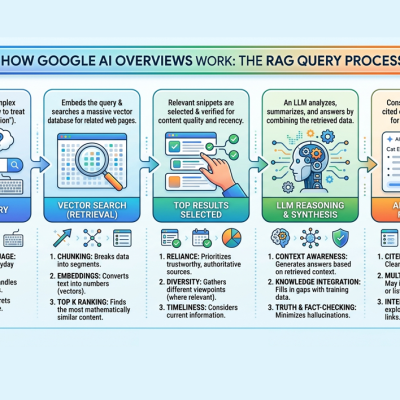
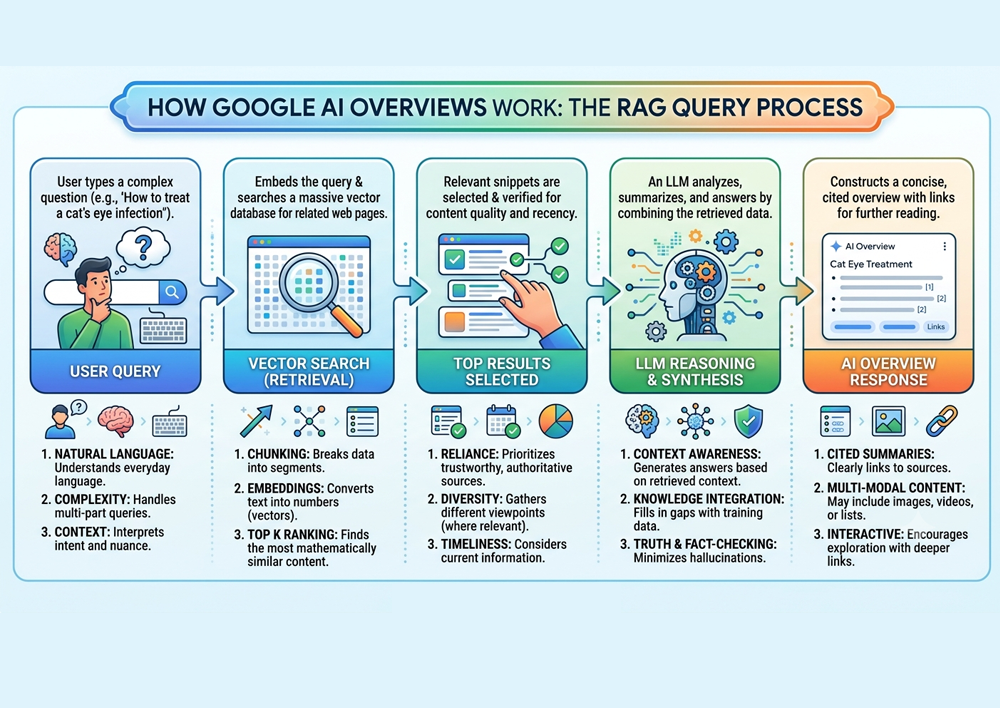
Retrieval-Augmented Generation (RAG) — grounding on the live index
The language model doesn’t formulate the answer based on its training knowledge, but rather retrieves content from the Google index in real time. The ranking systems decide which pages even enter the model’s “field of view.” The model then synthesizes the answer and visibly links to the sources that support its statements.
Key distinction: This is precisely where the AI Overview differs from a pure LLM chat. If you ask ChatGPT a question without web search enabled, the model answers based on its training data—frozen at a specific date, without source attribution, and without any live connection to the current web landscape. The Google AI Overview does the opposite: It grounds every answer in the current search index. This is why traditional SEO has such a direct impact on AI Overviews—and why visibility there correlates so closely with organic rankings. If you’re not in the index, you can’t be cited.
Query Fan-Out — one question, many searches
Definition. Query fan-out refers to the mechanism by which a language model internally splits a single user query into several thematically related search queries. These queries are executed in parallel in the index, each with its own ranking result, and the combined results are then incorporated into the generated answer. The model does this without user intervention—a single question internally generates multiple traditional searches.
Google itself provides an example in its guide: The question “How do I repair a lawn full of weeds?” generates parallel queries such as “best herbicides for lawns” , “remove weeds without chemicals” , and “prevent weeds in lawns” . These queries are all processed separately through the ranking algorithm, and the results are combined to create the final answer.
What this means strategically — and what it doesn’t —
At this point, many people have a misguided reaction: “So do I need a separate page for every variation?” No. This very reaction leads to what Google, in its guide, labels as Scaled Content Abuse —mass production of pages for every conceivable query variation, primarily to manipulate rankings.
The real conclusion is different, and it changes how we need to think about content clusters in the future:
- A single page needs to be broader and more in-depth in its content. If Google runs three to five fan-out queries for a user question simultaneously, the page that qualifies for the most of these queries wins. In the lawn example: The page that covers mowing, chemical options, mechanical alternatives, and prevention beats three thin pages, each covering only one aspect.
- The cluster logic remains, but it will become more holistic. Within a thematic cluster, individual pages may still delve deeper into specialized topics. However, the central hub pages must support the breadth of content.
- Synonyms and related topics are not additional pages, but rather integral parts of the same page. Google understands semantic relationships. An SEO page that also covers “search engine optimization,” “improving Google ranking,” “organic visibility,” and “top 10 placement” automatically addresses more fan-out queries—without requiring separate subpages.
Example: SEO Freelancer Hyderabad
Applied to our own Money-Page SEO Freelancer in Hyderabad : Those searching for an SEO Freelancer in Hyderabad rarely use this exact query. The actual search queries—and the resulting fan-out queries—look more like this:
“How much does an SEO Freelancer cost in Hyderabad?”
“Best SEO Freelancer Hyderabad “
“SEO Consultant Hyderabad Recommendation”
“Local SEO Hyderabad”
“Improve Google ranking in Hyderabad”
“Online Marketing Freelancer Hyderabad SEO”
The consequence: Our silo site must cover all these aspects—pricing structure, awards, consultant profile, local expertise, and concrete outcomes. And that’s exactly what we do. Not because we’re poaching long-tail keywords, but because we want Google’s model to identify our site as the most relevant source for as many fan-out variations as possible.
This is the difference between keyword thinking and query thinking . Keyword thinking asks: Which words do I need to include? Query thinking asks: What thematic depth do I need so that a model recognizes me as relevant for a whole family of related queries?
Five myths about Google AI Overviews that are officially dead
Google has a dedicated “Mythbusting” section in its guide. We’ll go through it one by one.
Myth 1: llms.txt and special AI markup files
For Google Search, llms.txt has no effect whatsoever. While Google may index the file, it is treated no differently than any other text file. A crucial point to note: For other AI systems beyond Google (such as Perplexity, Anthropic, and OpenAI), there is currently no unified standard, and some providers have expressed interest in such markup conventions. However, as long as there is no official, widely supported specification, llms.txt is at best an experiment—and certainly not a “GEO service” that an agency should charge for as a standard service.
Myth 2: “Chunking” the content
The idea of breaking content down into bite-sized pieces so that the language model “understands” it better is nonsense. Google itself says so: its systems understand nuances across entire pages and extract the relevant passage automatically. There is no ideal page length. Write for people, not for presumed model preferences.
Note: For in-house RAG pipelines (e.g., internal AI assistants with vector stores), structured content chunking can be quite useful; however, this is a different discipline than public search visibility.
Myth 3: Rewriting content to be “AI-friendly”
There is no specific notation for AI overviews. The models understand synonyms and semantic relationships. Anyone who thinks they have to include every long-tail term or formulate it in a particularly “clear AI style” is optimizing for a phantom. Our position on this extends beyond Google: there is no “AI notation” for ChatGPT, Claude, Perplexity, or Gemini either. These models are trained on human language. What humans understand clearly, they understand. What is a generic, interchangeable piece of content for humans is also a generic, interchangeable piece of content for them. There is no hack that circumvents this logic.
Myth 4: Buying inauthentic mentions
The “GEO consultants” who strategically place brand mentions in Reddit threads, forums, and listicle pages so that AI models “learn” the brand are working against Google’s spam systems. Generative AI search uses the same anti-spam filters as the traditional index. Artificial mentions have a short-term effect, if any, and carry a massive penalty risk.
It’s important to differentiate: For LLMs that rely solely on training data (such as ChatGPT without web search), long-term, organically grown brand presence on the web is certainly important—but this is precisely what arises from genuine visibility, real customer testimonials, and genuine expert articles, not from purchased Reddit posts. “Inauthentic” remains a spam signal on any platform.
Myth 5: Structured data as an AI requirement
Schema.org markup is not required for Google AI Overviews—Google itself officially states this. It’s important to clarify: This statement applies to Google’s own architecture. For other AI systems, especially RAG-based platforms like Perplexity or specialized crawlers, machine-readable structuring can indeed be advantageous—they sometimes explicitly enhance structured sources. However, blanket “AI booster” promises across all platforms are dubious. Regardless, Schema markup remains crucial for classic rich results in the SERP—and that alone is reason enough to implement it.